Your Load Plan Should Weigh Itself: The Axle Math We Are Working Out at Truck Packer
Gross weight is the easy limit. Axle limits and the Federal Bridge Formula are the ones that pull a tour truck into a scale house. Here is why spacing decides legality, plus a look at an unshipped prototype we are working through, with no promise it ever lands.

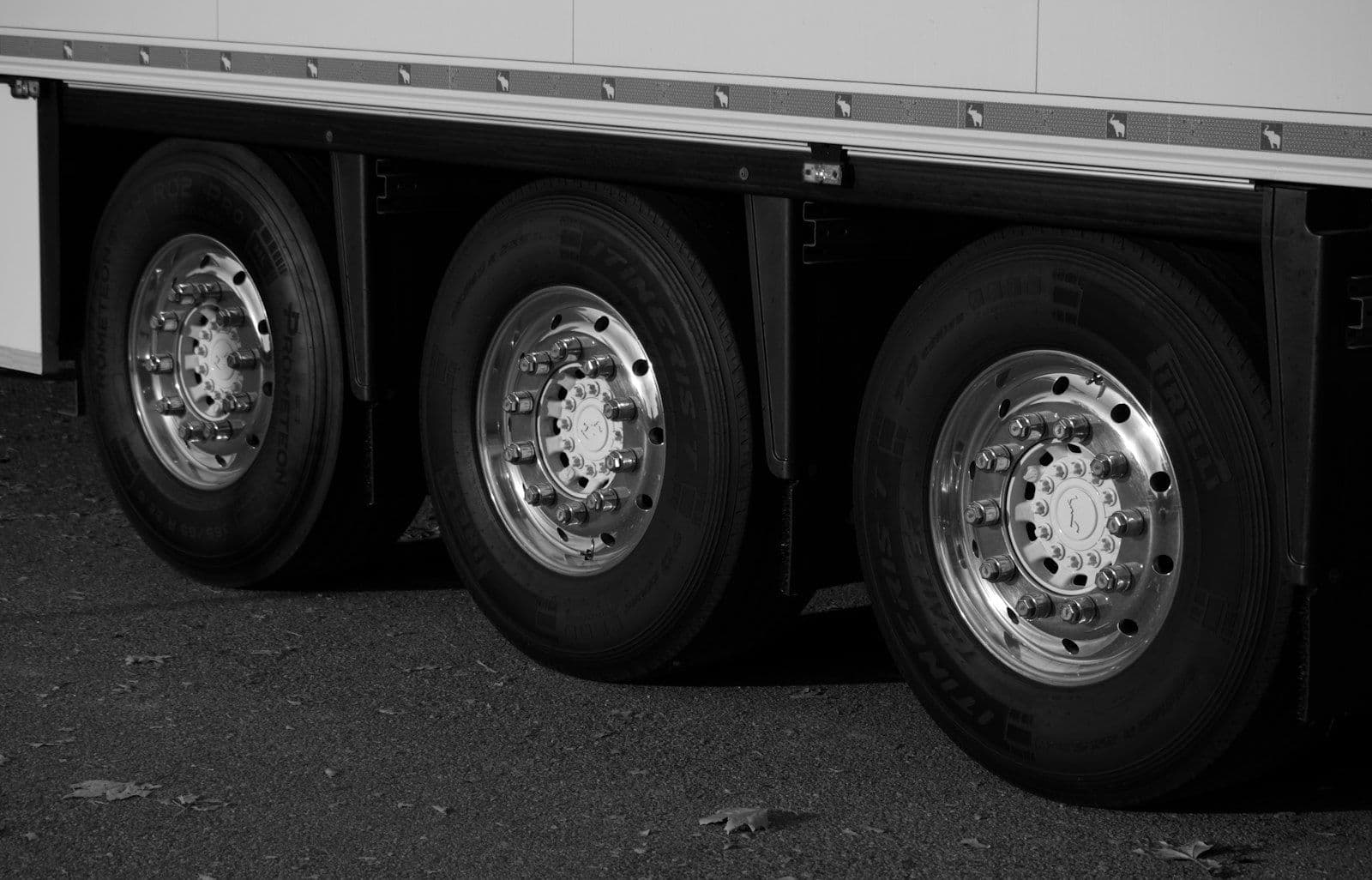
Every load plan answers one question well: does it fit. The question that actually gets a truck pulled into a scale house is a different one, and almost nobody answers it until the truck is already loaded. Where is the weight sitting.
A standard 53 foot dry van tops out around 45,000 pounds of cargo, because the tractor and empty trailer already account for roughly 35,000 pounds of the federal ceiling before a single case rolls up the ramp. On a heavy touring package, and a video wall or a motor package is a heavy touring package, you hit that ceiling long before you run out of floor. That part most production people know. The part that bites is that gross weight is only one of three numbers a DOT officer is looking at.
Gross is the easy limit. The other two are geometry.
Federal law on the Interstate system caps a single axle at 20,000 pounds, a tandem at 34,000 pounds, and gross vehicle weight at 80,000 pounds. On top of that sits the Federal Bridge Formula, which Congress enacted in 1975 to limit the weight-to-length ratio of anything crossing a bridge. It runs W = 500(LN/(N-1) + 12N + 36), where L is the spacing between the outer axles of a group and N is the number of axles in it.
The consequence is the one people miss. The formula can make a load illegal while the gross number is perfectly fine. A 25 foot three-axle dump truck is capped at 54,500 pounds by the formula, not 80,000, purely because its axles are close together. It works the other way too: two consecutive sets of tandems can each carry 34,000 pounds as long as the outer axles are 36 feet apart or more, which is exactly why a conventional five-axle semi is allowed to gross the full 80,000 in the first place. Spacing is the whole game.
None of that is theoretical for a tour. Amp racks, motors, and battery packs at the nose with empty wardrobe trunks at the tail is a legal gross weight and an illegal drive axle. You will not find that out on the loading dock. You will find it out at a scale, where Texas alone runs from $100 to $500 for under 2,500 pounds over up to $7,000 to $10,000 past 40,000 over, California reaches $0.20 per pound, and Tennessee charges $0.03 per pound within 10 percent. Then add the part nobody budgets for: offloading, storage, and a driver sitting still while the clock runs toward load-in.
What we have been poking at, and where it actually stands
Straight up before anything else, because we would rather say this too loudly than not loudly enough: none of what follows is in Truck Packer. It is a prototype on a feature branch, it is not on your account, you cannot go open it right now, and this is not a commitment to ship it, on any date or in this shape. Roadmaps move, ours included, and plenty of branches never make it out of the barn. We are writing about it because the underlying problem is worth explaining on its own terms, and because the parts we got wrong the first time were more interesting than the parts we got right.
The idea is easy to describe and was not easy to get right. Give the container real axles you can place and drag. Put a live per-axle weight readout under the bed and a tongue weight marker at the coupling. Fold tare into the math, flag a tail-heavy load, and recompute all of it while a case is still moving across the deck rather than after it is dropped.
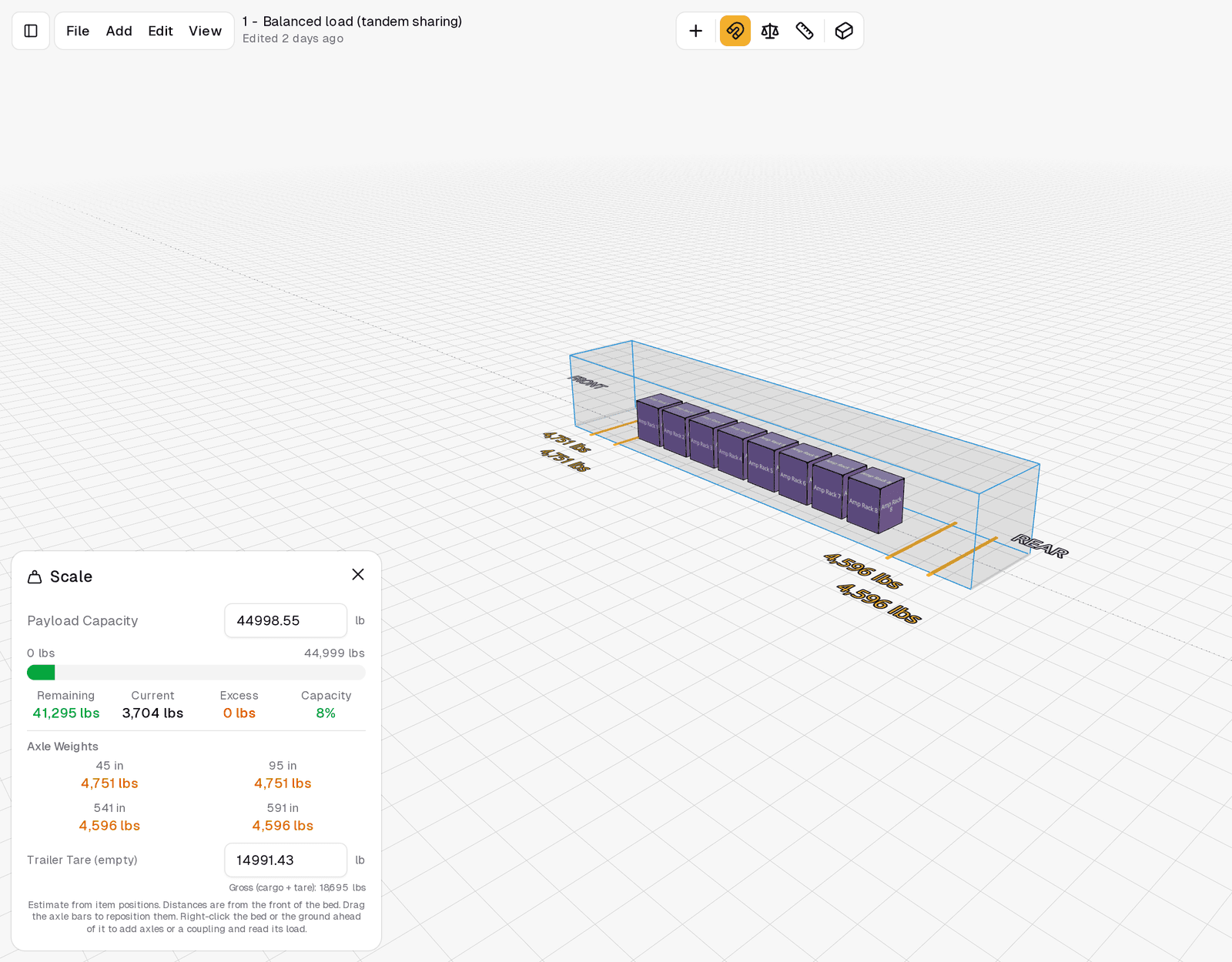
The prototype on the branch, not in the product. Eight amp racks over the nose of a 636 inch bed. The pair of labels under each axle group is the live readout, and the Scale panel folds the trailer's own 14,991 pound tare into gross.
The interesting problem is that a bed on three or more supports is statically indeterminate. Force and moment equilibrium give you two equations and more than two unknowns, so rigid-body statics genuinely cannot answer it, and the usual shortcut of assigning each case to the two supports on either side of it falls apart the moment two supports sit close together. It turns a pair of axles inches apart into a lever with almost no moment arm and prints enormous reactions that are not real. Solving the bed as one body on spring supports reproduces the exact textbook answer for the two-support case, degrades smoothly for every other case, and lets every case on the deck act on every support in proportion to where it actually is.
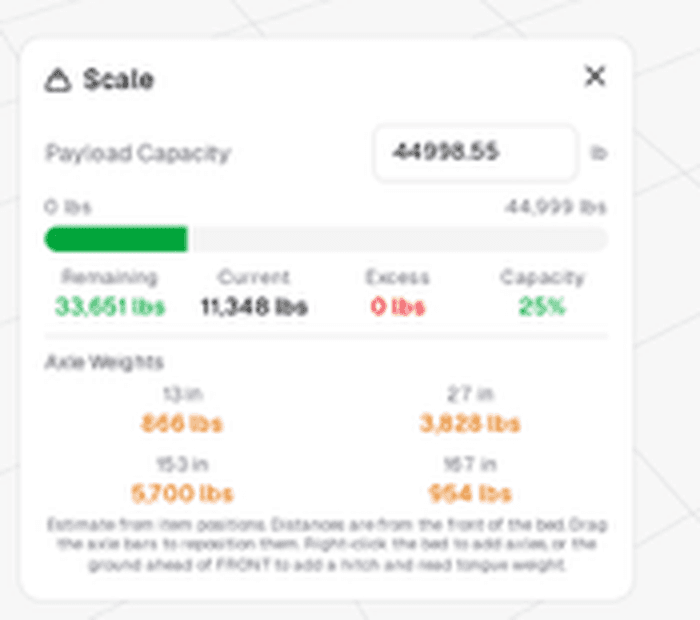
What the shortcut printed on a real Colony House pack before the rewrite: 866 and 3,828 pounds across one equalized tandem, 5,700 and 954 across the other. Equalizer hardware physically cannot load like that. A scale would have read roughly 2,350 and 3,330 per pair.
Two calls out of an engineering review this month are worth writing down whatever happens to the branch. Negative tongue weight should be shown, not clamped to zero. It is real, it means the tongue is floating, and that is a sway hazard you want to see rather than have quietly rounded away. And the forward coupling has to be a type, not a label: bumper pull, gooseneck, or kingpin. The familiar "tongue weight should be 10 to 15 percent of gross" figure is bumper-pull guidance. A gooseneck runs deliberately higher, and a semi kingpin is not governed by a percentage at all, it is governed by the tractor's fifth-wheel rating and the drive-axle rating. So a kingpin gets its computed number with no in-band verdict attached. A missing verdict is honest. A wrong green is not.
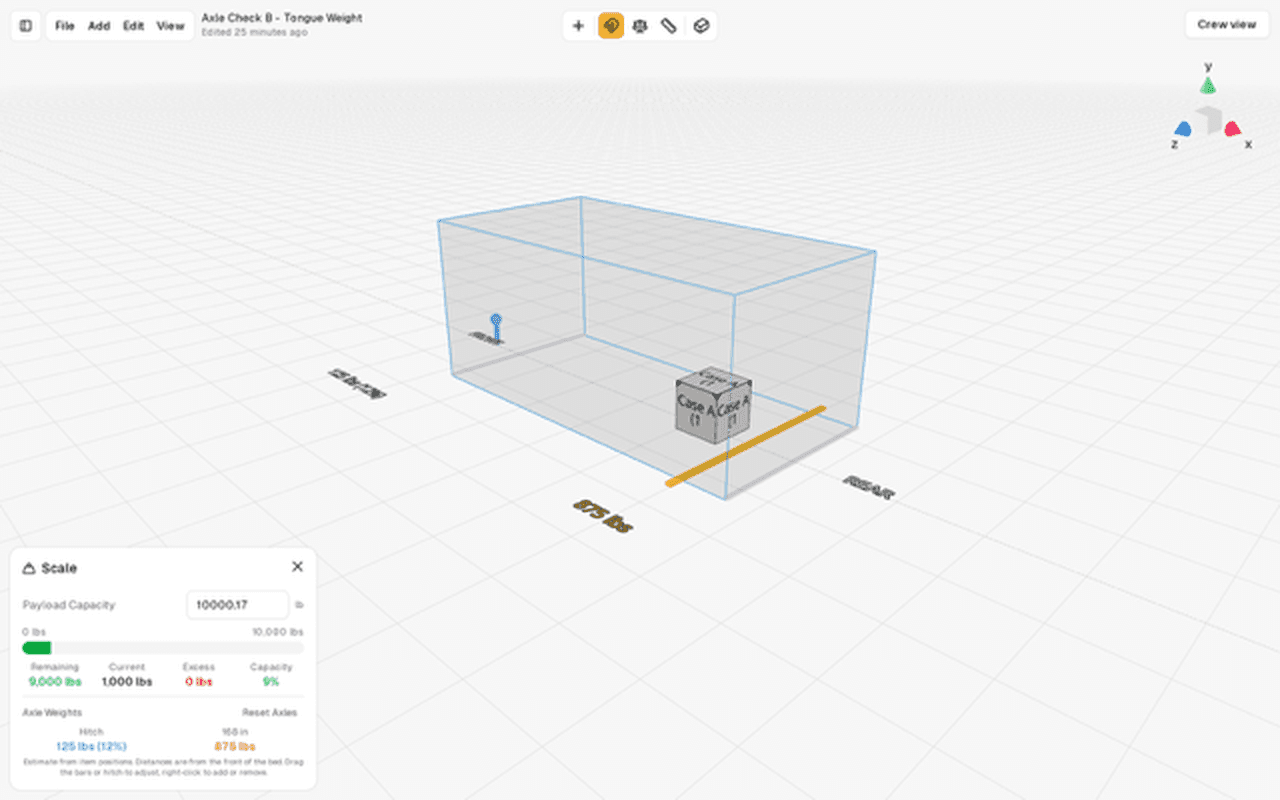
The two-support case, where the lever rule is exact physics rather than an approximation: 1,000 pounds at 12 feet, a coupling 2 feet ahead of the bed, 875 pounds on the axle and 125 on the tongue at 12 percent.
Why we think it is worth the work
Whatever ends up shipping, and we are not promising that anything does, a software readout is a planning tool and not a certified scale, so cross a scale anyway. The thing worth chasing is moving the discovery from the shoulder of an interstate to the point in the advance where changing your mind is free. Which case goes where has always been a weight decision as much as a space decision, and right now the weight half of that decision gets made by feel and confirmed by a fine. That is the gap, and it is the reason we keep picking this one back up.
In the meantime, the bridge formula is not waiting on anybody's release schedule. If you are routing a heavy package this fall, the cheapest thing you can do is pull your trailer's axle spacing and run the numbers by hand before the truck is loaded, not after.
Ready to build your load plan? Log in to Truck Packer and pack it.

