Which Cases Never Stack, and Why
The stacking rules a crew chief carries in their head, written down: what ATA 300 actually requires of a lid, why caster dishes decide the stack, the caster math on threes instead of fours, and which cases are never on the bottom. Tell us where this is wrong before we build it.

Truck Packer will stack anything on anything. Put a 40 pound utility trunk under a 300 pound amp rack and the 3D view looks fine, the weight readout looks fine, and the plan is wrong. Every shop already carries the real rules in somebody's head, usually the crew chief who has watched a lid fold. Monday we asked which roadmap item should ship next, and Stackable Packing Constraint is on that list as "improve the packing algorithm to account for cases that should/should not be stacked." Before we build it, here is the version of those rules we have collected, so you can tell us where it is wrong.
The lid is not a floor
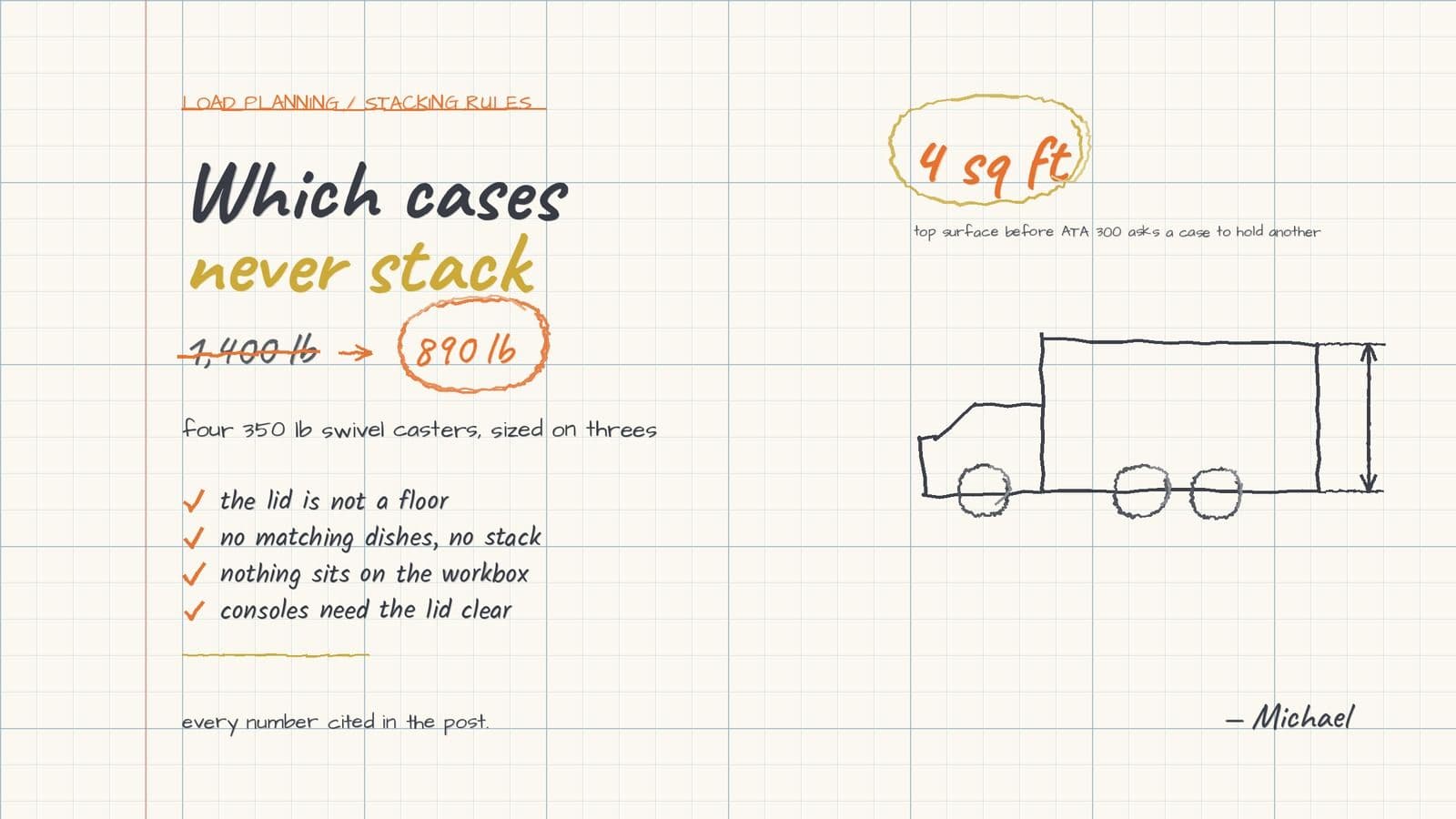
A road case is only built to carry another case when it is big enough to be worth building that way. Under ATA Specification 300 Category I, a container has to withstand the weight of another container stacked on it once its top surface exceeds 0.37 square meters, roughly four square feet, and the stacking ball corners are what actually carry that load into the frame. Below that size the spec does not ask for it, so nobody pays for it. That is most of your small utility cases, your mic trunks, and every drawer case in the shop.
The practical read: load goes through corners and edges, never through the middle of a lid. A case with a full-width lid and no ball corners at the top is a shelf that has not failed yet.
If the dishes do not line up, it is not a stack
Caster dishes are the recessed cups in the top of a case that a caster drops into. They exist to keep the case above from rolling off the case below, and they only work when the footprint above matches the footprint below. Two cases of different widths with mismatched dishes are not stacked, they are balanced, and they stay balanced until the driver takes a highway ramp.
This is the rule that trips up mixed inventory. A shop that bought the same truck pack trunk twice can stack it two or three high all day. The same shop's odd one-off cases, built for a specific piece of gear, usually have a flat top and no dishes, and they belong on the floor.
Do the caster math on threes, not fours
Casters are rated per wheel, and the number on the spec sheet is not the number you get. CasterHQ's rule is to size per caster at total load divided by three, not four, because on a worn floor or a ramped truck deck one of the four is routinely off the ground. They also note that a swivel caster de-rates 15 to 20 percent against a rigid one, since the load rotates on a smaller raceway, and most road case casters are swivels.
Run that on a real case. A heavy ATA trunk rated to 1102 pounds of contents on four 350 pound casters looks like 1400 pounds of capacity. Divide by three and you have 1050. Take 15 percent off for swivels and you are near 890, and that is before you set a second loaded trunk on top of it. The bottom case in a stack is carrying its own contents plus everything above it through four wheels that were sized for one case.
Some cases are never on the bottom, some are never on top
Weight is the obvious rule and it is not the interesting one. The ones that actually change a pack:
- Anything opened before the truck empties. The workbox, the tool case, the merch trunk, the case with the show drive in it. If it gets opened at the door, nothing sits on it.
- Anything with a tilt-back or a fold-down front. Console cases and doghouse-style racks need the lid clear to open, and a case on top means striking two cases to get to one.
- Amp racks and anything fan-cooled. They are heavy, so they want to be low, and they usually have rear doors that need clearance in the truck if the crew powers up from the truck.
- Anything with a soft top. Cable trunks with domed lids, cases with recessed lids, drum hardware trunks that are already bowing. Look at the lid, not the label.
Everything else is a candidate, and candidates are what an algorithm can actually solve.
Why this is a constraint and not a checkbox
The truck pack is also a wall. 49 CFR 393.106 asks that every article of cargo be in contact with, or close enough to, a wall or other articles that it cannot shift or tip enough to affect the vehicle. In a tour pack that is not achieved with straps, it is achieved by packing tight, and packing tight means stacks. Killing stacking to be safe costs you a row, and a row on a 53 footer is real money on a fall run.
So the feature we want is not a "do not stack" flag on a case. It is a per-case rule with a reason attached: cannot bear load, cannot be under anything, must stay accessible, must stay on the deck. Different reasons, different behavior from the packer.
That is the part we would rather get from you than guess at. If your shop has a rule that is not on this list, or one of these is wrong for your inventory, tell us and it goes in the spec.
Ready to build your load plan? Log in to Truck Packer and pack it.

