The Load Planning List We Are Not On
In August 2026 SourceForge ranked 30 load planning tools and Truck Packer was not one of them. It is now, at fifth of 51. An honest head to head against Cube-IQ, EasyCargo and Cargo-Planner, run on one real 59-case tour load, with the screenshots attached.

Update, October 7, 2026: SourceForge's list is now 51 tools deep and Truck Packer is on it, ranked fifth. The rest of this post stands as written in August. Current picks and prices are in Best Load Planning Software in 2026.
SourceForge keeps a running directory of load planning software, thirty products deep, ranked and priced. Cube-IQ sits at the top. EasyCargo is second. Cargo-Planner is fourth. Scroll the whole list and you will not find Truck Packer on it, which is a fair thing for a buyer to notice before they hand us a credit card. So rather than argue about the ranking, here is the honest version: what those tools do, what we do, and one real tour load run through our packer with the screenshots attached.
What the top of that list is actually built for
Cube-IQ is a serious piece of software. It does containerization, truck loading, pallet building and cartonization, ships as both a desktop app and a SaaS with SOAP and REST APIs, and it will hang off Oracle, SQL Server, Sybase or DB2 through ODBC, with route mapping through Google or Bing (Capterra). That is a tool for a company with a product master and an IT department.
EasyCargo is the friendliest of the three. You define the cargo space, feed it weights, measurements and constraints, and it calculates the plan in interactive 3D. It groups items by destination for multi-stop runs and it does account for axle weight distribution, which most of this category ignores. Pricing runs $9.70 for a one-day ticket, $79 per user per month, or $67 a month billed yearly (Capterra).
Cargo-Planner is the freight forwarder's pick. Its packlist reader parses most Excel layouts without a template, it covers sea containers, road trailers, air containers, pallets and breakbulk, and it runs in 18 languages. Lite is $99 a month for one user, and notably that tier does not include interactive 3D. Standard is $139 a month for five users and does.
The thread running through all three is that they are cartonization engines. They are extremely good at the problem of "I have 400 identical cartons and a 40-foot box, how many fit." That is a real problem. It is just not the problem a production manager has at 6am in a loading dock.
A tour load is not four hundred cartons
Here is a real one. Colony House's 2025 bus trailer, 15 feet by 7 feet 10 inches by 7 feet 10 inches, 59 cases, 11,348 pounds against a 44,999 pound capacity.
Every one of those 59 items is a one-off. There is a 3 CH Guitar Vault, a CH Amp Trunk, an IO Rack, a Hazer, an item literally called 77 SIGNS, a Will Drum Riser, a waves server, and a stack of merch and hoodie boxes that shrinks every night of the run. None of it repeats. There is no product master to import. Nobody is optimizing fill percentage, because the trailer is the trailer and the gear is the gear. The actual question is what order it comes off in and whether the guitar vault is buried behind the merch when the backline tech needs it first.
The pack, and the sheet the crew reads
This is the load in 3D, every case named the way the crew names it:
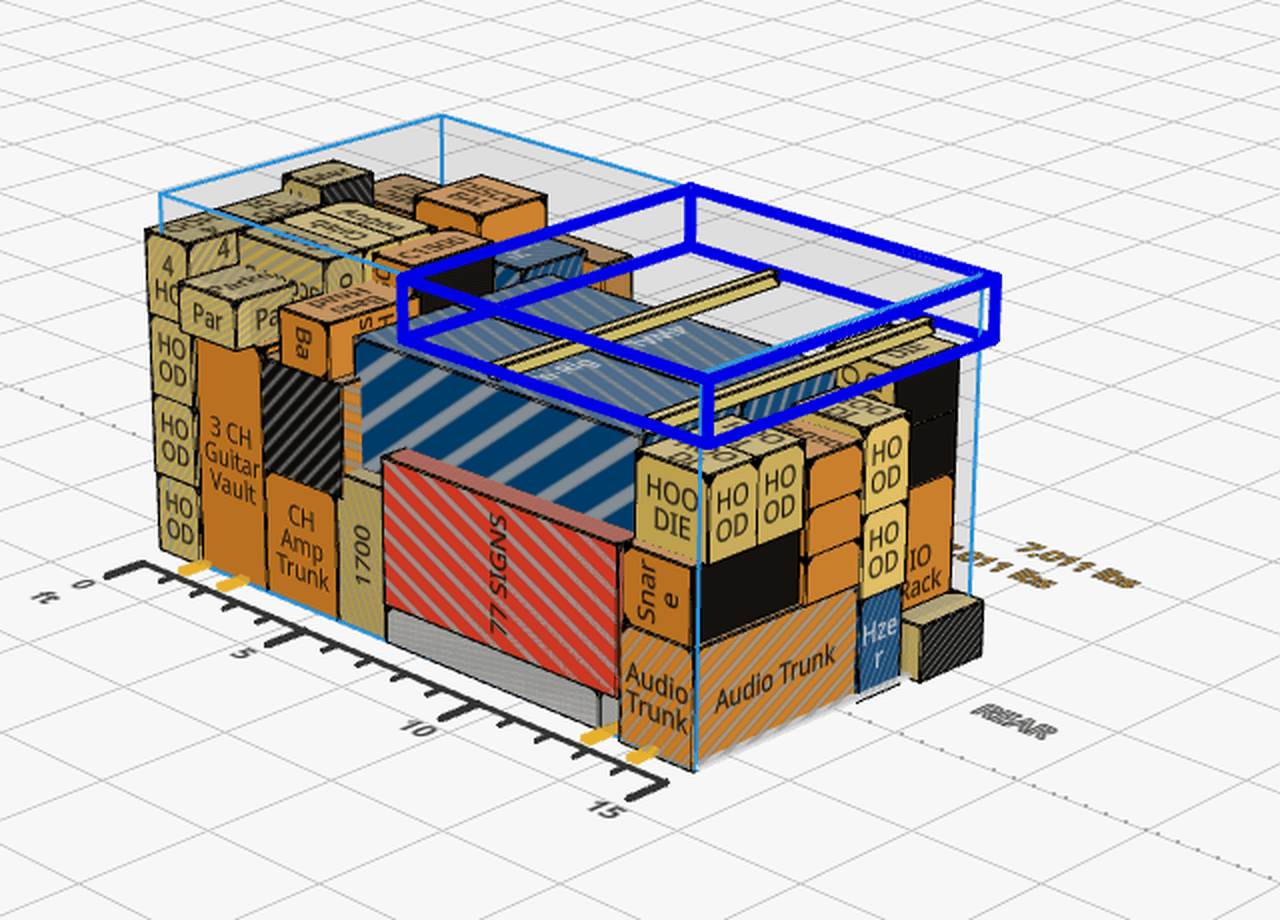
3D view of the Colony House bus trailer pack, 59 named road cases.
The part that matters more is the second view. Crew view flattens the same pack into a top and side diagram with a title block and a numbered case checklist, and it is what actually goes to the driver and the load crew:
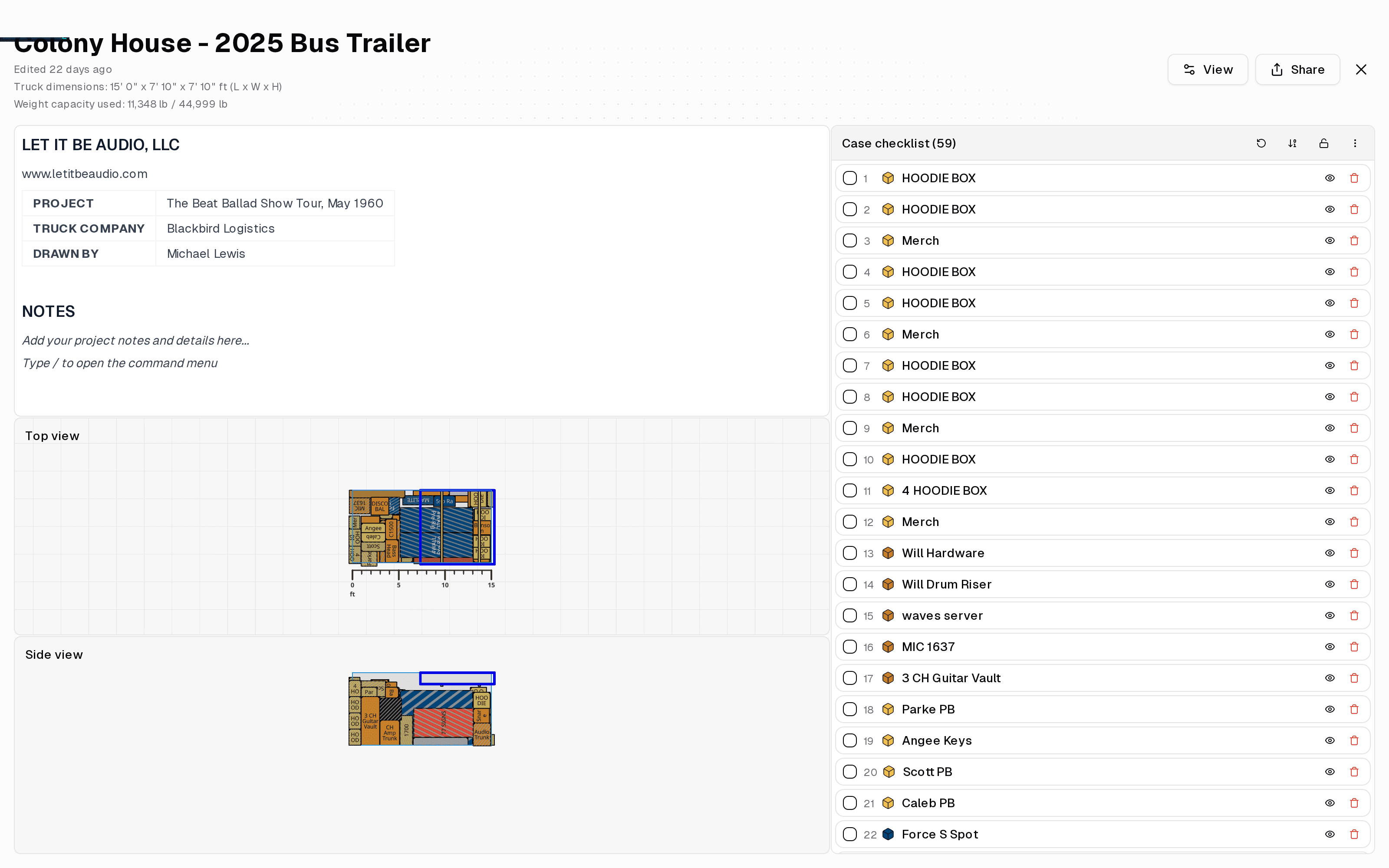
Crew view: title block, top and side diagrams, and the 59-item case checklist.
That is the difference in one image. Cube-IQ will give you a beautiful 3D diagram of a container. Cargo-Planner will parse your Excel and stuff a 40-footer. Neither one produces a document that a loader who has never seen your gear can work off of at the top of a ramp, with the cases named the way they are stenciled and a checkbox next to each one.
Where we are honestly worse
We do not have an ODBC connector. We do not read your Excel packlist with a generic parser the way Cargo-Planner does. We do not run in 18 languages. If you are a freight forwarder loading sea containers out of a WMS, one of those three is a better fit than we are and we would rather tell you that than sell you the wrong thing.
What we do have is the touring case. Pro is $28 a month for a single user, which is under half of EasyCargo's monthly seat and roughly a third of Cargo-Planner Lite, and it includes the interactive 3D that Cargo-Planner puts behind its $139 tier. Business adds seats, collaboration, API access and SSO (pricing).
Not being on the SourceForge list was a marketing problem, and it's fixed: we're fifth of 51 now. Being the only one of the four built around a named road case instead of a carton is the actual product, and that we are not fixing.
Ready to see your own load this way? Log in to Truck Packer and build the pack.

